Beacon Poll: January 2026 Results

Today, we released the latest installment of the Beacon Poll, a statewide survey of 1,200 Tennessee voters featuring questions about voters’ views on property taxes, the federal school choice tax credit included in the One Big Beautiful Bill Act, and political approval ratings at the state and federal level, and more.
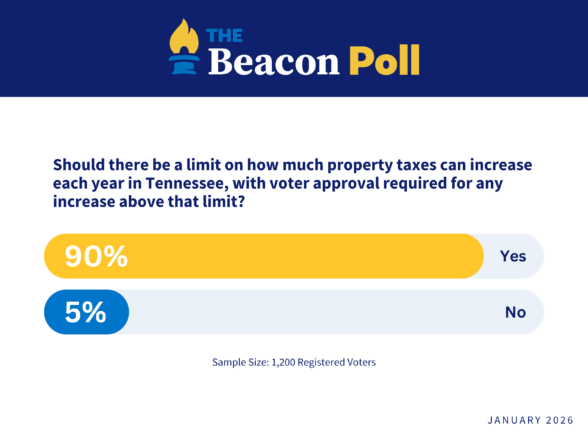
Tennesseans continue to prioritize key state issues. The results show overwhelming bipartisan support for property tax reform in Tennessee, with a staggering 90% of voters backing limits on property tax increases and voter approval for larger hikes. As families across the state face rising property tax burdens, Tennesseans support stronger protections against unchecked property tax increases. Support for the measure has grown since a year ago, when 81% of voters backed the idea. Interestingly, 91% of both Republicans and Democrats agree that a referendum should be held if localities raise property taxes above a certain limit.
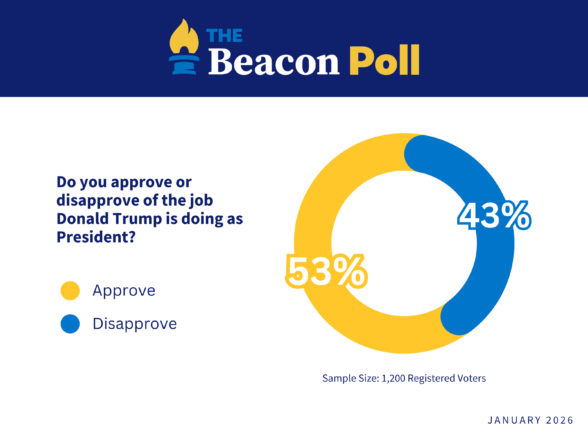
While President Donald Trump’s approval remains solidly above water in Tennessee, it has fallen to its lowest level since the Beacon Poll started tracking, marking a notable shift among voters. Currently, 53% of voters approve of the job he is doing, while 43% disapprove, a six-point difference from the November 2025 Beacon Poll. Trump’s approval remains strong among Republicans (+73%), but it has dropped sharply among Democrats (-77%) and Independents (-14%), reflecting growing dissatisfaction outside of his base.
As the gubernatorial primaries draw near, discussions about the candidates are intensifying across Tennessee. Senator Marsha Blackburn continues to maintain a commanding lead among Republican contenders. As it currently stands, 56% of Tennesseans plan to support her in the gubernatorial primary election, which is a 47-point lead over Congressman John Rose (9%), and a 49-point lead over State Representative Monty Fritts (7%). Since the November Beacon Poll, Blackburn’s support has dropped two points, Fritts has gained two points, and Rose has remained steady at 9%, showing only minor shifts in the race at this early stage.
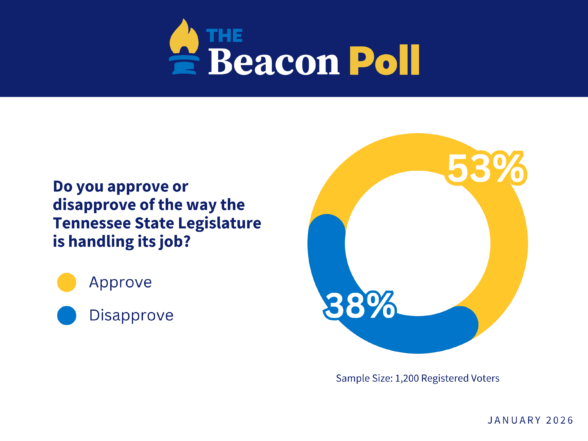
As the legislature returned to Nashville this past month, Tennesseans expressed a generally favorable view of the General Assembly. The legislature’s approval rating sits at 53%, while 38% disapprove of the job they are doing (+15%). Support is strongest among Republicans (+55%), mildly above water with Independents (+3%), and underwater among Democrats (-45%).
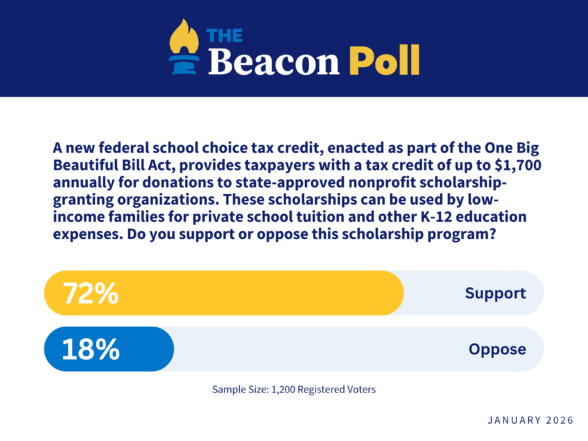
Tennessee voters are overwhelmingly supportive of the federal school choice tax credit included in the One Big Beautiful Bill Act, which provides taxpayers with a tax credit of up to $1,700 annually for donations to state-approved nonprofit scholarship-granting organizations. Low-income families can use these scholarships for private school tuition and other K-12 education expenses. A whopping 72% of voters back the measure, while just 18% oppose it. Support spans party lines, with Republicans (+76%), Independents (+56%), and Democrats (+15%) backing the measure, reflecting broad support for school choice.
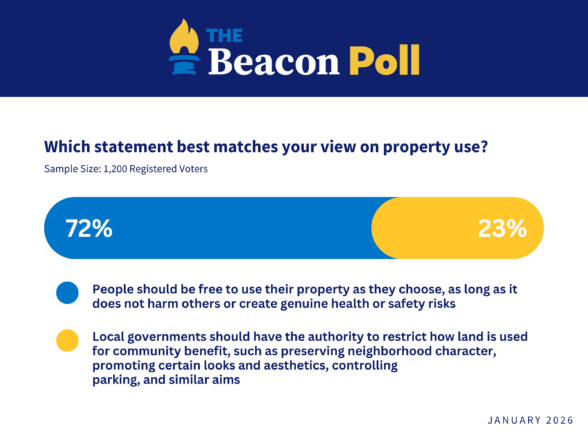
Tennesseans overwhelmingly believe in the fundamental right to control their own property. Most voters (72%) agree that people should be free to use their land as they see fit, provided it does not harm others or create health and safety risks. Only 23% support giving local governments the authority to restrict land use for community purposes. Support spans party lines, with Republicans (73%), Independents (77%), and Democrats (64%) backing the principle of individual freedom over bureaucratic control.
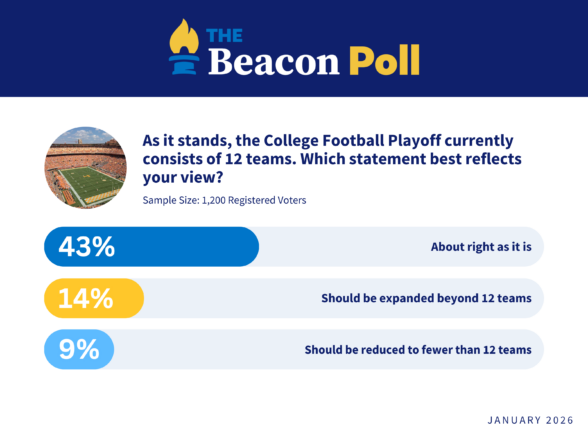
Following a thrilling NCAA football playoff that saw Indiana complete its Cinderella story with a National Championship victory, Tennesseans are divided on what the future should look like for the College Football Playoff. While both the Southeastern Conference and Big Ten want an expanded playoff of 16 or 24 teams, a plurality of voters (43%) believe the playoff should remain at 12 teams. Only 14% favor expanding the field, and just 9% support reducing the number of teams. Thirty percent of voters are not familiar enough with college football to form an opinion.