
Since 2020, Beacon has been calling for Tennessee to join 46 other states in providing a fundamental taxpayer protection: a property tax cap. While the Volunteer State has mulled the idea of a cap for years, this legislative session is different from past ones. As residents faced staggering tax bills, the conversation looks to has shifted from “maybe” to “must.” Multiple proposals have been introduced in the legislature, which has increased conversation around these taxpayer protections. With so much media coverage and discussion regarding a property tax cap, what is the reality of such a policy, and is one needed in Tennessee?
Myth: This is only a big city problem.
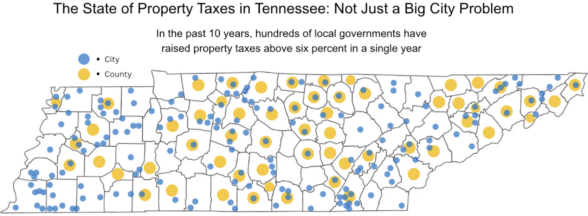
Fact: From major metros to small towns, few Tennessee residents have been spared from massive tax increases. Nashville is widely seen as the worst offender, raising taxes 60 percent in five years, but the capital city is not an outlier, as many think. Cities like Mt. Juliet and South Pittsburg both raised taxes by three-digit percentages in recent years. In fact, in the last decade, hundreds of local governments all across the state, no matter the size, have passed large single-year increases on Tennesseans.
Myth: A property tax cap restricts local governments from raising needed revenue.
Fact: A property tax cap does not prevent local governments from raising new revenue or freezing their budgets. Simply put, a property tax cap allows local governments to still grow revenue up to the cap. To go beyond the cap, they make their case directly to voters through a referendum. This isn’t a restriction on increased revenue; it’s an invitation for resident input, which is the truest form of local control. This protection gives taxpayers a say in large increases, and compels local government officials to make the case for such increases while focusing on funding core government services. This is simply accountability while still providing local governments with options to raise more revenue, if residents agree.
Myth: A property tax cap would make cities have to cut basic services.
Fact: Unsurprisingly, the 46 other states with some form of a property tax cap are still able to fund core government services like police departments and schools. This myth has been proven time and time again to be false; yet this is the general scare tactic local governments use when discussing a property tax cap, that core services are first in line on the “chopping block.” With a cap, local governments look for efficiencies and prioritize core government services before spending tax dollars on non-government functions like pickleball courts, buying a hotel, a mall, or funding a new stadium.
Myth: Large property tax bills are due to inflation and rising property values.
Fact: Tennessee’s current Truth in Taxation law requires property tax rates to decrease to a revenue-neutral level after a reappraisal, preventing local governments from receiving a windfall of revenue with rising property values. Yet the law does not prevent local governments from raising the property tax rate above and beyond the revenue-neutral rate. Local governments choosing to raise rates after a reappraisal are largely the source of increased property tax bills, not simply rising property values.
A property tax cap is a basic, common-sense taxpayer protection, and 46 other states have instituted a cap to protect residents from massive, unexpected tax hikes. Importantly, when paired with a referendum, local governments can still raise taxes above the cap, while providing voters a say in large increases, resulting in a more efficient government that truly serves its people. This layer of accountability should be supported by residents and local governments alike. While Tennessee has been a leader in many areas, it’s time for the Volunteer State to join the vast majority of other states in 2026 and provide taxpayers with protection and stability by capping local property taxes.